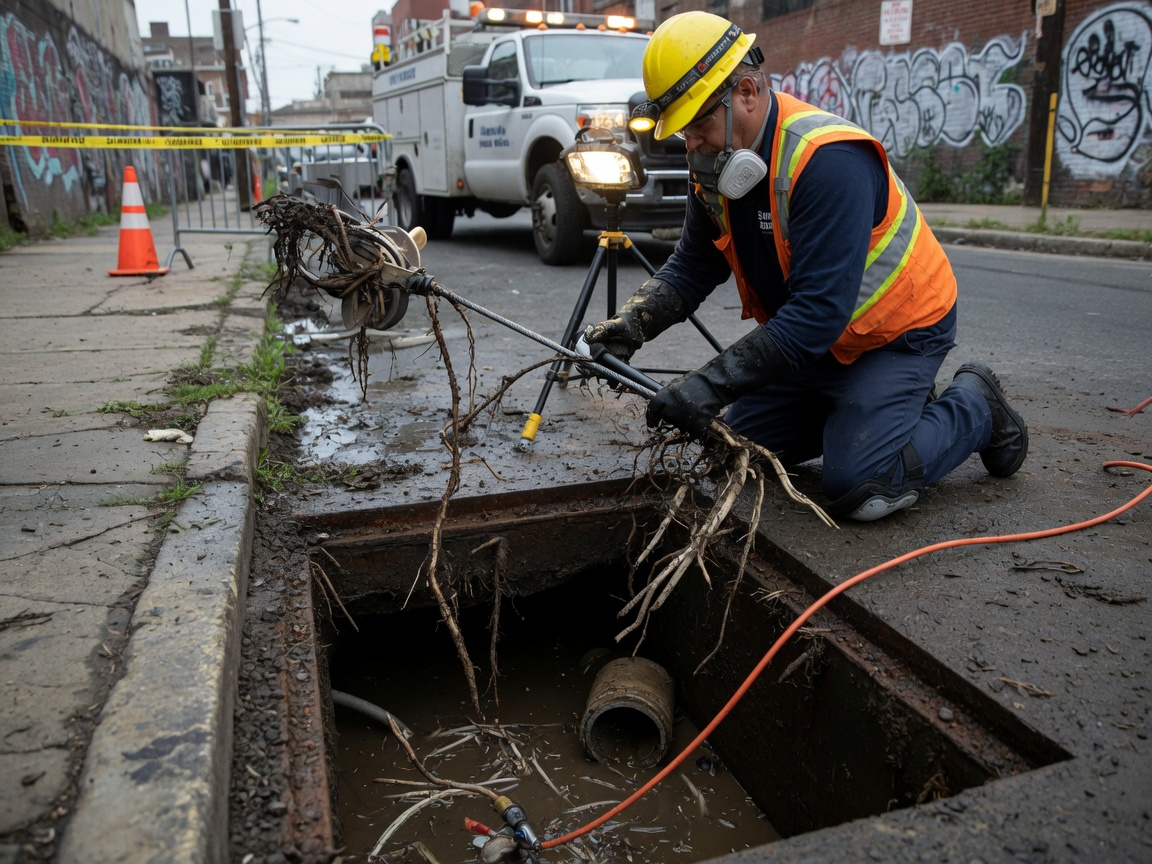
Newark homes built before the 1980s in neighborhoods like Downtown Newark and Oaklands often have clay or cast-iron laterals that crack or separate, giving roots an easy entry point. Roots from maples and willows common near White Clay Creek and the Newark Reservoir follow moisture trails and can fill a four-inch line within one growing season. In cold winters the ground contracts and roots may recede slightly, but the damage to joints remains and backups return with spring rains.
Mechanical cutting alone leaves root hairs that regrow quickly in New Castle County’s loamy soils. Hydro jetting at 3,500–4,000 psi combined with a root-cutting nozzle removes the mass and scours the pipe wall so regrowth slows. We avoid chemical foams near the reservoir and University of Delaware campus because runoff rules in New Castle County are strictly enforced. Camera inspection before and after confirms the line is clear and documents any offset joints that will need excavation later.
Access points matter. Many West Newark and Hillside Heights properties have cleanouts buried under driveways or behind Bob Carpenter Center-area townhomes, requiring concrete cutting or landscaping removal. South Newark homes on slab foundations sometimes route the main under the slab, so we use sectional machines rather than full hydro jetting to avoid flooding the basement. Every job ends with a recorded video so homeowners see exactly what was removed and what the pipe condition is now.
Seasonal timing affects the work. Late fall after leaf drop is ideal because roots are still active but water tables are lower, giving better visibility. Summer jobs after heavy rain can turn a simple cut into a muddy excavation when saturated soil collapses around the lateral. We always locate the line with a sonde before digging so we don’t hit unmarked utility laterals common in older sections of Hockessin Road corridors.
Technician insight
In Newark the thing that catches most people out with sewer root removal is how fast roots return in the wet soils along White Clay Creek and the reservoir. Older clay lines in Oaklands crack at every joint, so a simple cut without jetting just buys a few months. Homeowners often try root killer first and end up with a worse clog when the dead roots break off and jam downstream.
Recurring backup after heavy rain in West Newark
A homeowner on a street near the University of Delaware reported backups after every summer storm. Camera inspection showed dense root intrusion through a cracked clay joint 35 feet from the cleanout. We performed mechanical cutting followed by hydro jetting, then flushed the line to the main. The recorded video showed clear flow restored and the homeowner was advised to monitor for future joint movement.
Sewer Root Removal Services We Offer
✓Hydro Jetting Root Removal
High-pressure water jetting clears root masses and scours pipe walls in Newark laterals where mechanical cutters alone leave regrowth material.
✓Mechanical Root Cutting
Powered cutting heads slice through dense root intrusions in older clay lines common in Downtown Newark and Oaklands without requiring full excavation.
✓Sewer Camera Inspection for Roots
Locates root entry points and joint damage in lines serving homes near White Clay Creek State Park before any cutting begins.
✓Root Barrier Installation
Physical or chemical barriers placed along the lateral to slow future root intrusion from mature trees in South Newark yards.
✓Post-Root-Cut Line Flushing
Thorough flushing after root removal ensures debris does not settle and create new blockages in New Castle County sewer mains.
Sewer Root Removal Cost in Newark, DE
| Service | Typical Range | What Affects It |
|---|---|---|
| Standard residential root cutting | $350–$650 | Single cleanout access, lines under 60 ft in Oaklands or Downtown Newark |
| Hydro jetting after cutting | $200–$400 | Added when roots have left heavy debris in older clay pipes |
| Camera inspection only | $150–$250 | Diagnostic visit when backup cause is uncertain |
| Excavation add-on | $800–$1,800 | Required when roots have caused joint separation or collapsed sections |
Ranges are typical for Newark, DE and confirmed with an exact written quote before any work starts.
How it works
- 1
Locate And Inspect
We map the sewer lateral using a sonde and run a camera to identify root density, pipe material, and any offsets in Newark homes.
- 2
Select Cutting Method
Based on inspection we choose hydro jetting, mechanical cutting, or a combination suited to the line size and access in the specific neighborhood.
- 3
Clear The Roots
Technicians cut and flush roots while monitoring flow to the main, protecting nearby landscaping and hardscaping in West Newark or Hillside Heights.
- 4
Verify And Document
Final camera pass confirms clearance and records pipe condition for the homeowner and any future New Castle County permitting needs.
Pricing
Cost depends on access difficulty, pipe length, and whether excavation is required.